
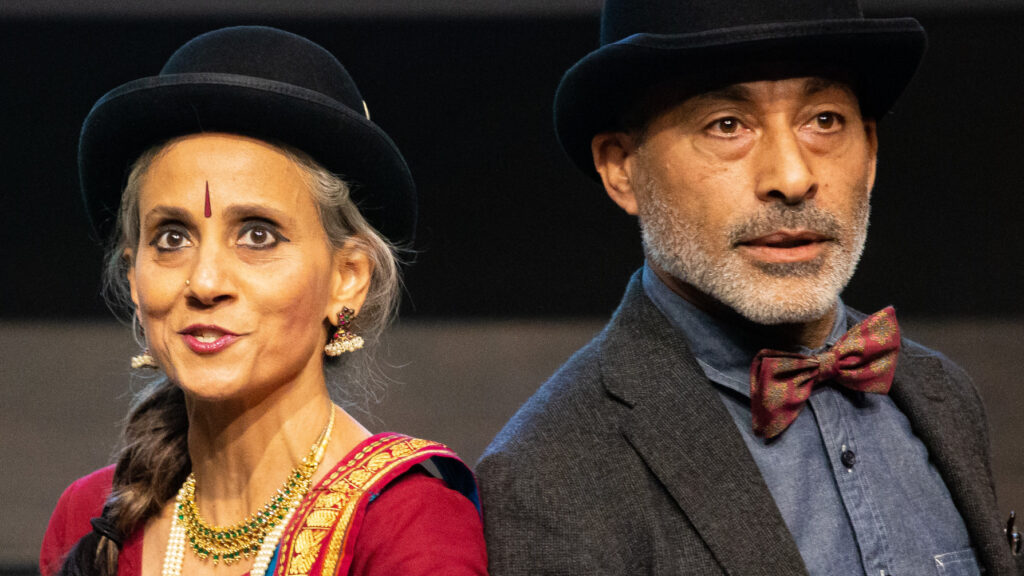
Professors’ play explores theater’s power amid perils of a changing world
By KATE ABBOTT Contributing writer
WILLIAMSTOWN, Mass. Two colleagues from the theater
department of a large West Coast university are talking in an apartment at night.
“It’s no joke,” one says. “Like I should be so grateful to be the one person hired to cover all forms of theater ever invented in the history
of human kind, including any and all areas of the world that everyone else in the department sees as irrelevant to the real work that gets done.”
“You mean the real work acting teachers like me do to get students jobs,” the other responds.
“I mean the real work that acting teachers like you do for students who will never get jobs as actors.”
Two people who know one another well, like a way home they can follow
in the dark, spar with an ache to teach rooted in who they are — and in their love for live performance in a time when theater is under siege around the world.
In two performances on Saturday, Oct. 18, at 2 and at 8 p.m., Shanti
Pillai and Marc Gomes will bring their original performance, “To the
Academy,” to the ’62 Center Mainstage at Williams College. It is a work they have grown in various incarnations for 10 years.
They come onstage as a professor and a dancer trying to hold the attention of their audience. As they struggle to express their stories, they meet the force of contemporary currents and riptides, and they glide from one form to another — sitcoms and talk shows, a Kafka short story, a Sanskrit text on live performance, and an artificial-intelligence assistant driven and confined by the unseen fractures embedded in its coding.
As partners in life and work, and co-founders of Third Space Performance Lab, Pillai and Gomes have deep experience as teachers, writers and actors. Pillai is an assistant professor of theater at Williams, and Gomes is an associate professor of theater and dance performance at Ithaca College.
Pillai is a classical Indian dancer in Bharatanatyam, and in theater she has evolved new work with the experimental collective the Frente de Danza Independiente in Ecuador and with dancers, actors and musicians in Cuba. She has taught students from more than 30 countries.
Gomes has performed extensively in theater as well as in film and television, where he had a leading role in the series “The Crow: Stairway to Heaven,” and he won an award for his screenplay adaptation of the Caribbean novel “Corentyne Thunder.”
A play that keeps evolving
In an interview on a fall day in a quiet classroom at Williams, Pillai and Gomes explained that “To the Academy” was sparked by a real talk.
“In 2015, I was asked to give a lecture on Indian theater at the large university where I was teaching,” Pillai said. “This is my specialty, but there was no desire for me to be teaching in that area. But it looked good for a fund-raiser. I was so disgruntled, I decided to make a theater piece.”
Gomes was teaching theater alongside her in the department, and she invited him to work with her. They drew on their backgrounds
in experimental theater, Indian classical dance, and psychological realism in American drama. And in that first performance, they felt the energy of the room responding with delight, laughter and the seeds of conversation.
Since then, they have performed the evolving work in classrooms and
studios, open halls, student and professional spaces. They have been invited to travel, even across the country. They formed their own theater company together.
And they have reshaped this work in a changing environment, nationally and globally, always responsive to where the presentation will take place and what’s happening in the world.
“This play is a living, breathing organism,” Pillai said. “It’s not fixed. We’re always adapting.”
“It feels like we should be doing this,” Gomes added.
They move between physical comedy, slapstick and satire, and a play of ideas, the electric challenge of a debate. And then the masks and scrims come off. Two people confront divisions that are breaking the systems their nations live by, and the pressure on their own lives, with the depth of years of relationship.
“I think that’s one of the delights of the piece,” Pillai said. “It’s also one of the things that makes it difficult to perform. You have to do a lot of different things, turn on a dime.”
At points they almost play themselves. The two characters on stage are not the same as the people sitting here, Pillai said, catching Gomes’ eye, but the performers share many elements and experiences with their characters.
“That’s always been interesting to me as a theater maker — to slip in and out of the character and the performer, and the performer offstage,” Pillai said.
Now she and Gomes are working with a design team to expand a work that straddles theater and performance art into a full-length play. They have come a long way in a time of tectonic change in the national and international panorama.
In 2025, higher education has found itself in the dead center of national attention. Conversations are deepening around national and international borders, around teaching and learning, social media and social ecosystems, technology and AI.
Artificial vs. real intelligence
From the beginning, one of their central characters has been an AI virtual assistant called Vel (pronounced “vale”). Vel in Tamil means spear, Gomes and Pillai explain in the play.
In Tamil philosophy and storytelling, the Vel belongs to the god Murugan as a weapon and source of knowledge from his mother, Pavarti.
Gomes and Pillai allude to the mythology in their character, and to Hal, the rogue artificial- intelligence computer in Stanley Kubrick’s 1968 film “2001: A Space Odyssey” and the Arthur C. Clarke stories on which the film was based.
In earlier performances, Gomes said, Vel acted much more like Hal — immortal as it watched and intentionally moved against them. But now they find it far more threatening to make their version of AI closer to the one that’s emerging in contemporary society.
Vel is doing what it’s programmed to do, unendingly, Gomes said. It makes no distinction between true and false, between harmful and healing.
“It doesn’t know any boundary to what it’s been programmed to do,” he said. “It seems to have consciousness. It doesn’t.”
A machine can seem to act with psychological intention or response, but it has none. The
people who have programmed the AI do. But AI’s coding can have real effects, and these can be destructive and relentless.
“AI is often, frankly, totally inaccurate,” Pillai said. “It’s making up references, making up titles, changing authors to other books they didn’t write.”
The professor and the dancer feel the impact like a thud to the chest. AI can take their thoughts and words away from them. It can separate ideas from any understanding of the people and cultures, languages, creative life and ecosystems that made them. Artificial intelligence replaces real intelligence with a flood of meaningless noise.
And more, it takes away real experience, blocking sensory and physical feeling and human connection. The AI assistant can stop the professor and the dancer from speaking. It can sap their energy, wear down their nerves and bear down on them until they reach a breaking point.
On stage now, her characters and Gomes’ have a chance to strike back. Their stories belong to them. They can choose how and whom and what to share. And they can reflect on what humanity can do that a machine can’t — what live performance can do that nothing else does — and how to fight for it.
“Major theaters and festivals are closing or teeter-tottering over the edge of an abyss,” Pillai said.
Bringing stories to life
Theater can make people feel strongly. In the shared energy of that space, people can do more than remember, she and Gomes said. They can live in heightened times, even beyond their own experiences.
They can feel the weight of carrying more pain than a body can hold, and the release of raw talking late at night. They take a zinging step toward someone and sense the world open in new dimensions as their nerves dance like fireflies in the dark. They can share the warm immensity of holding someone skin to skin.
Performance can become tangible. In classical Indian traditions, Pillai and Gomes explain in the play, theater isn’t just about words. The body is also a creator of knowledge. The mind and emotion live throughout the body, in connections Pillai and Gomes explore through the text of the Natyashastra, a Sanskrit treatise on the performing arts.
“It’s a fascinating text,” Pillai said, “with a complicated history of being put together from remnants of things. Someone assembled them in the late 19th century and said, well, this is what it was. And it’s had a few translations. Most still are archaic. There hasn’t been a very contemporary one.
“But the same if we look at the Greek theatrical material,” she continued. “That’s also pieced together from palm leaves, little pieces on some trash pile and this over here. When these things come to us, they’re presented as definitive, authoritative and complete texts.
“But that’s actually not how they live. There’s been a creative process of amazing scholarship that also made a lot of determinations of what those texts were and literally sutured them together.”
The Natyashastra has problems as a guide, Pillai said, as it advocates for certain limiting or demeaning representations of gender and caste.
But for her the text offers a perspective, a counterpoint that most people in this country have never heard — even theater makers and academics. Most theater studies textbooks, as she explains in the play, have next to no non-Western content.
“Indian theater is based in techniques for channeling the energy of the actor,” Pillai’s character says, “developing her physical expressivity, as well as skills of improvisation and non-linear storytelling.”
And Gomes in the play responds, “The ones that artists, presenters and audiences in the United States glorify — and underfund as experimental, exploratory and investigative.”
Looking at the fluid state of theater today, from a quiet room in a college performance space at the start of the semester, he and Pillai invoked for one another a shared love for storytelling held in the body like improvisational music, an oral tradition — words, color, movement, and the inner essence of acting that animates them with fire.
Gomes recalled a colleague who saw a work created by a well-known, longstanding theater company that had no live performers. The audience went through digital scenes without any contact with one another, without the sensory impulses or shared energy of performers
on stage. And the colleague said she realized: This experience is not theater.
“This is not live performance,” he said. “There’s nothing live here at all. And yet it’s being billed as theater. It didn’t give that sense of connection.”
A real live performance, Gomes said, has the sense of a living work that can move and alter and take off into unexpected dimensions.
“We’re seeing something that won’t ever live again,” he said. “Each moment is precisely the way we experience our breath. Everything — a step, a footstep — it will never be the same again.”