
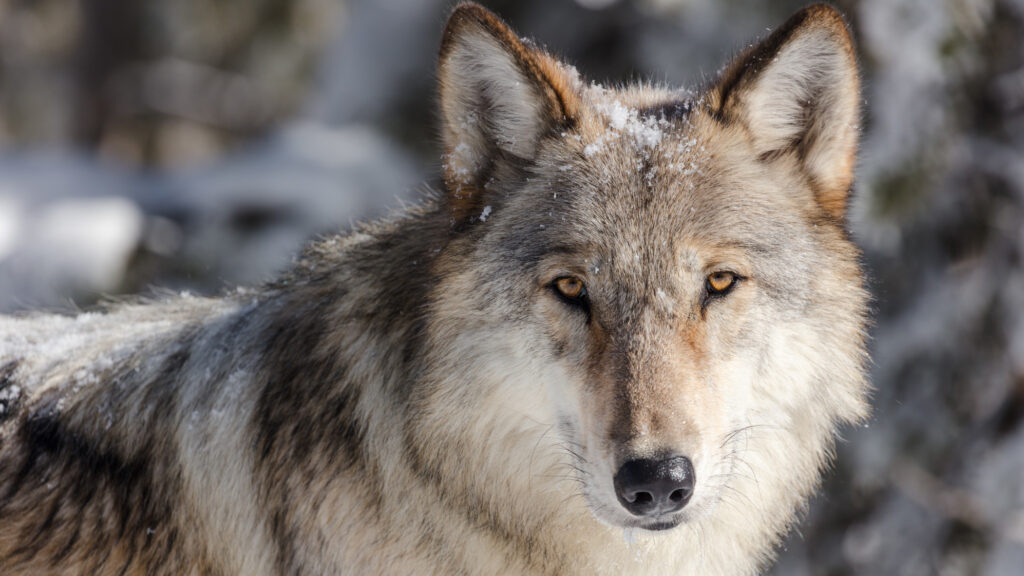
Groups push N.Y. and Vermont to monitor, protect large canids
By MAURY THOMPSON Contributing writer
The image of wolves as fearsome predators goes back centuries, reinforced in children’s stories and fables from “Little Red Riding Hood” to “The Three Little Pigs.”
And it’s natural for humans to have some level of fear of wolves, said David Gibson, managing partner of the environmental group Adirondack Wild.
“We exist with that fear, and it’s a good thing to have,” Gibson said in a recent telephone interview. But people also should respect the role wolves play in the ecosystem — and the potential role wolves and other canids could play in fighting climate change, he added.
Gibson’s organization is among more than a dozen conservation groups participating in the Northeast Wolf Recovery Alliance, a coalition formed in 2023 to promote the recovery and protection of wolves across the Northeast and in eastern Canada.
Wolves were once native to northern New York and New England, but a government-sponsored bounty system eradicated them from the region by the early 20th century. There are still documented wolf populations north of the Canadian border in Ontario, however, and in the Great Lakes states from Michigan to Minnesota.
Some area conservationists say wolves from these adjacent regions are already wandering into northern New York and New England — and could perhaps begin to form a viable local population with a little help.
As a result of the new coalition’s efforts, state legislators in both New York and Vermont have proposed new laws aimed at better documenting the presence of wolves and protecting them from hunters who might confuse them with coyotes.
Conservationists also have been pushing lately for protection for wolves in state wildlife action plans that are revised once a decade.
Opponents question the need for these on the cover page, a gray wolf that was killed by a hunter in otsego county who mistook it for a large coyote is displayed at the New York State museum. Above, a wolf at Yellowstone National Park.
efforts, however, and wildlife experts at the state Department of Environmental Conservation in New York say it’s unlikely wolves will ever make a measurable comeback in the Northeast.
“The DEC has always been adamant that there are not wolves in the Adirondacks,” state Sen. Dan Stec, R-Queensbury, said in a recent interview. Stec is the ranking Republican on the Senate Environmental Conservation Committee.
Mistaken for a coyote
The debate over the presence of wolves in the region has intensified over the past few years after a 2021 incident in which a hunter in the Otsego County town of Cherry Valley killed what he thought was a very large coyote. He contacted the DEC, which initially deemed the male animal to be a coyote-wolf hybrid.
But subsequent genetic testing revealed nearly a year later that the animal was actually 99 percent gray wolf.
“That was a wake-up call,” Gibson said.
Testing showed the wolf had been eating a wild diet, and some conservationists say the discovery of a wolf in Cherry Valley — more than 150 miles south of the Canadian border — bolsters their belief that more wolves could be moving through the woods of northern New York and New England.
The DEC maintains, however, that the Cherry Valley wolf is one of only three that have been documented in New York in the past 25 years. Another was found in 2001 in Saratoga County, near the border of the Adirondack Park, and the third was documented in 2005 in Cayuga County.
“Beyond these occasional instances, there is not evidence of a breeding population in New York,” the DEC says on its website. “Currently, the probability of a wild wolf population becoming established in the state is very low.”
The issue is complicated, however, by the fact that wolves, coyotes and dogs all can interbreed.
Claudia Braymer, executive director of the environmental group Protect the Adirondacks, said in a phone interview that canids with wolf genes may have already migrated naturally to the region from either Canada or the Great Lakes states. Braymer’s organization is another member of the Northeast Wolf Recovery Alliance.
The discovery in recent years of canids with wolf genes elsewhere in the Northeast has convinced environmentalists in northern New York and Vermont there is hope the region may someday once again have an ample wolf population.
“Wolves are naturally returning to the Northeast, representing the beginning of a necessary healing of the ecosystem,” said Elizabeth Ahearn, a conservation associate with the Sierra Club Atlantic Chapter, in a news release.
Gibson, of Adirondack Wild, argued that could yield environmental benefits. An over- population of white-tailed deer in the Northeast, increasingly unchecked by hunters, has resulted in over-consumption of the flora that’s important to reducing climate change, he explained.
Hunting is the primary method for managing deer herds, according to the New York state Deer Management Plan for 2021-2030. But since the mid-1980s, the number of licensed deer hunters in the state has consistently dropped off at a rate of about 2 percent per year, according to the report.
The annual deer harvest peaked in 2000, and has fluctuated since without coming near the 2000 level.
Restoring a healthy population of wolves would provide a natural predator species to thin deer herds and replenish the supply of flora and fauna important to a balanced environment, Gibson said.
The hoped-for resurgence could suffer an early demise, however, if wolves are mistaken for coyotes, which can legally be hunted in the two states, environmentalists warn.
“Wolves returning to New York could usher in the next great rewilding success, but not if dispersing wolves are misidentified as coyotes and killed once they set foot within the state,” said Nadia Steinzer, carnivore conservation director for the group Project Coyote, in a news release.
Legislation calls for reporting, testing
In New York, proposed legislation would require anonymous reporting to the state Department of Environmental Conservation of the killing of wolves and coyotes, with the DEC required to conduct genetic testing of any wild canid reported that weighs 50 pounds or more.
If a canid were identified as a wolf or as having wolf genes, the DEC would be authorized to take measures to protect other wolves in the vicinity. The DEC would be required to submit a report of its genetic testing and findings to the Legislature in 2029.
Public education is another intent of the bill, Braymer said.
The Assembly Environmental Conservation Committee voted 20-9 in May to advance the legislation. Senate companion legislation — S5402A — was introduced and referred to the Environmental Conservation Committee, where it was not discussed this session.
Environmental groups say they will continue to push for passage in both the Assembly and the Senate in 2026, the second year of the two-year legislative cycle.
Assemblyman Matt Simpson, R-Lake George, who voted against the bill in committee, said the proposed law would be ineffective, because hunters and trappers are not likely to voluntarily report killing a canid, out of fear it could be construed as illegally killing a wolf.
Wolves are protected under both federal and state law, and it is illegal to hunt or trap them.
The proposed legislation specifies, however, that information gained from voluntary submission of canids for testing cannot be used as evidence for violation of state wildlife law.
To allay the concerns of hunters and trappers, language was recently added to the proposed legislation specifying that canids could be submitted anonymously for genetic testing, Braymer said.
The New York Conservation Council, a sportsmen’s advocacy group, is concerned genetic testing of coyotes over 50 pounds would consume DEC staff time and resources and take away from other important tasks, said Bruce McGowan, the group’s executive director.
McGowan also questioned the need for the legislation. There may be “random” instances of canids with wolf genes in New York, but it does not appear there is a realistic chance of it becoming common, he said.
Echoes of 1990s conflict
Simpson said in an interview earlier this year that he suspects the proposed legislation may be a precursor to another attempt by environmental groups to reintroduce wolves in the Adirondacks.
In the mid-1990s, the U.S. Fish and Wildlife Service identified the Adirondacks as one of three locations for possible reintroduction of the Eastern timber wolf.
The national group Defenders of Wildlife, based in Washington, D.C., opened a regional office and
conducted a multi-year study of the biological and sociological feasibility of reintroducing the Eastern timber wolf in the Adirondacks.
The group eventually abandoned its effort after heated opposition from hunting, farming and property rights groups — and from local government officials.
Hunting groups said wolves could prey on the deer herd, and farming groups said they feared wolves would destroy livestock.
Based on these concerns, the Essex County Board of Supervisors enacted a local law in 1998 banning the “importation, liberation and release” of wolves and other “dangerous predators” in the county. At the time, supervisors in Washington County discussed passing a similar local law.
Environmentalists insist the intent of the current legislative proposal is not to lay the groundwork for another wolf reintroduction attempt.
“We do not see this as a precursor to reintroduction in an artificial way,” Braymer said. “It’s really just a research bill. It’s a bill about getting data and information.”
Gibson, of Adirondack Wild, offered a similar message.
“We’re not calling for a reintroduction of wolves in the Northeast,” Gibson said. “We’re calling for awareness. That’s what this legislation is calling for: education and awareness.”
Supporters of the legislation say they want to determine to what extent canids with wolf genes are migrating into New York from Canada, Maine or the Great Lakes region.
Wolves can travel up to 1,000 miles, Braymer said.
“We do hear anecdotal reports about people seeing wolves in the Adirondacks,” she said. “There are at least canids in the Adirondacks that have wolf genes.”
But the DEC contends those instances are exceedingly rare.
“We have documented a few wolves and wolf hybrids over the last 20 years in New York,” the agency says on its website. “In most cases, we believe these animals were released from captivity. However, wild wolves are present in Algonquin Provincial Park in Ontario, and it is possible for these animals to travel to New York.”
But Gibson said large coyotes weighing 50 pounds or more have been more commonly spotted around the Northeast. Their size is an indication these animals may have wolf genes, he said.
The typical coyote weighs between 25 and 45 pounds and measures 3.5 to 4.5 feet long from nose to tail, according to the DEC. The typical wolf weighs between 50 and 100 pounds and measures 5 to 6 feet in length. The Cherry Valley wolf weighed 85 pounds.
Calls for hunting restrictions
In Vermont and New Hampshire, environmentalists are seeking to limit the hunting season for coyotes.
New York currently allows coyote hunting
from Oct. 1 to March 29 in most counties, with the exception of New York City and Long Island, where coyote hunting is prohibited year-round.
In Vermont, coyotes can now be hunted year- round.
Sarah Gorsline, Vermont state director of Project Coyote, said she will petition the Vermont Fish & Wildlife Department this fall to limit coyote hunting in the state to a season from Oct. 1 to Dec. 31, which effectively would prohibit hunting during coyotes’ months of birth and infancy.
If the department accepts the petition, it would schedule a public comment process on the proposed restriction.
Vermont Coyote Conservation Council, another wildlife organization, petitioned the department unsuccessfully in 2022 to limit coyote hunting.
Gorsline said she wants to gauge the reception from regulators before Project Coyote considers pursuing legislation.
In the next legislative session, Project Coyote will advocate for three bills that were introduced this year but did not make headway.
One bill, H132, would ban using bait, such as meat piles, to hunt “furbearer species” including coyotes, bobcats, fishers, foxes and raccoons. The proposed legislation does not ban using bait in trapping of furbearers.
A second bill, H166, would restrict using hounds in hunting of various species, including bears and coyotes. The bill would require visual supervision of hunting hounds at all times.
The third bill, H326, would further restrict the use of mouse and rat poisons in Vermont. “This bill would benefit coyotes and other wild carnivores species like foxes, bobcats, fisher and raccoons, as well as raptor species like eagles, owls and hawks, all of whom can experience secondary poisoning from eating rodenticide-poisoned rodents,” Gorsline explained.
State wildlife action plans
In late September, a coalition of wildlife groups issued a news release criticizing the New York DEC for not including wolves as “a species of greatest conservation need” in its draft wildlife action plan for the coming decade. The designation would allow the state to seek federal funding for conservation measures.
“We strongly urge the department to reconsider its position and follow the lead of other Northeastern states that recognize the value of including these species in their conservation strategies,” said Christopher Amato, conservation director for Protect the Adirondacks.
New Hampshire and Maine have already designated wolves “a species of greatest conservation need,” and Vermont is “poised” to do so, according to the news release.
Contacted for a response, DEC spokesman
Jeff Wernick shared an article by Dan Rosenblatt, head of the Wildlife Diversity Section of the agency’s Division of Fish and Wildlife.
“Understanding that it may be possible for wolves from source populations in Canada or the Upper Great Lakes to enter the state, DEC is committed to documenting any observations of potential wolves in New York,” Rosenblatt wrote in The Conservationist magazine, a department publication.
He explained that a 1999 Conservation Biology Institute study concluded there was sufficient habitat for wolves — but that establishing a permanent wolf population in New York was unlikely.
“Those that reach New York on their own are most likely the best suited for survival once they arrive,” Rosenblatt wrote. “Should wolves reach New York in the future, they will be afforded protection under state and federal law.”
Awaiting a federal plan
There also is potential regulatory action affecting wolves at the federal level.
The U.S. Fish and Wildlife Service, in a lawsuit settlement reached in December 2023, agreed to post a draft wolf recovery plan on its website by Dec. 14 of this year, kicking off a yearlong public comment period.
On Feb. 2, 2024, the Fish & Wildlife Service announced it was beginning the process of preparing the draft report.
“We thought things had been proceeding well,” said Amaroq Weiss, senior wolf advocate for the Center for Biological Diversity, which had brought the original lawsuit that resulted in the settlement.
But the settlement agreement allowed the Fish & Wildlife Service to stop producing the wolf recovery plan if it found the effort “would not aid in the recovery of the species.”
Since President Trump took office in January, the Fish & Wildlife Service has provided no information about whether it is continuing to prepare the draft plan or if it will conclude that it will not aid in recovery of the species. The Trump administration fired more than 400 of the agency’s employees, or about 5 percent of its work force, in February.
The deadline for action is still looming.
“Our hopes are still the same,” Weiss said in a telephone interview. “But our expectations are different from our hopes.”
Weiss said she expects her organization will go back to court if Fish & Wildlife concludes that a recovery plan will not aid in recovery of the species — or if the agency lets the deadline pass without posting the draft report.