
Stefanik’s entry into governor’s race sets up a clash
By MAURY THOMPSON Contributing writer
Supporters in her northern New York district and Republican allies around the state say U.S. Rep. Elise Stefanik represents the ideal GOP candidate for next year’s governor’s race.
They argue that Stefanik, who formally de- clared her candidacy on Nov. 7, has the political skills and fund-raising prowess a Republican will need to convince voters that New York needs to change course – and to break more than a decade of one-party Democratic control in Albany.
But Democrats and some nonpartisan analysts say the choice of Stefanik as the GOP candidate could be a gift to incumbent Gov. Kathy Hochul – and to down-ballot Democratic candidates across the state. Many of them see Stefanik as a hyper-partisan warrior. And as one of President Trump’s most outspoken allies, they say, she is unlikely to appeal to swing voters in a deep-blue state where the president remains deeply unpopular.
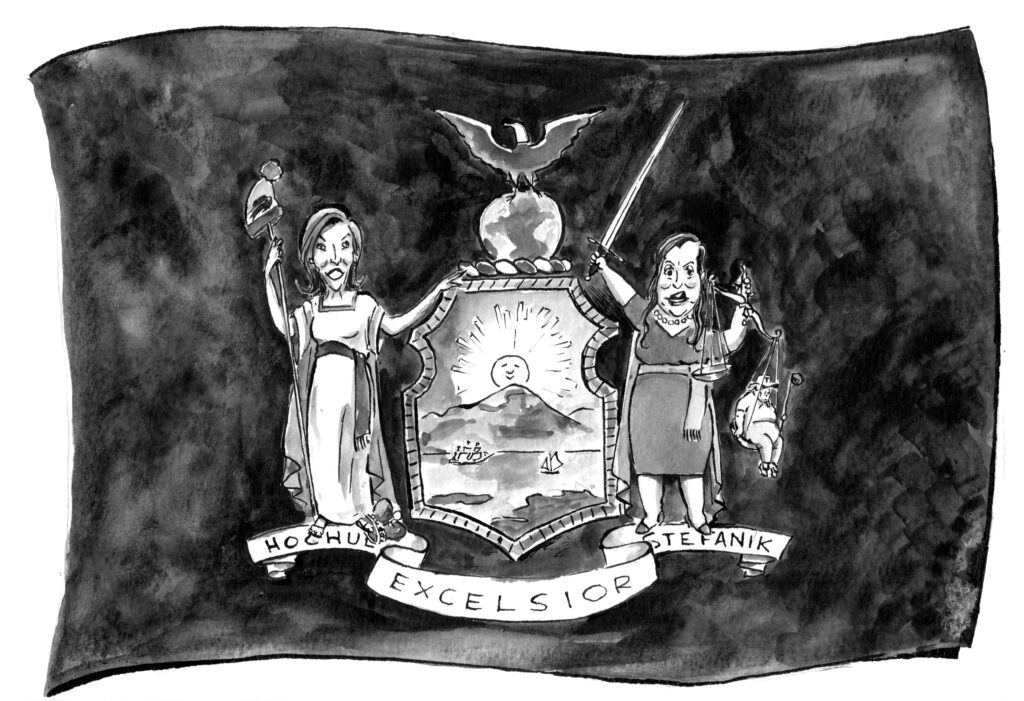
Both Hochul and Stefanik still face declared or possible primary opponents next year, though neither appears vulnerable to a serious intraparty challenge so far. If they become their parties’ re- spective nominees as expected, New York’s first- ever gubernatorial contest with women leading both major parties might wind up breaking other barriers, such as for campaign spending – and perhaps for vitriol.
The issues that will animate the campaign are already taking shape, with Stefanik and her allies focusing on public safety concerns as well as the state’s high cost of living. Democrats are focusing on Stefanik’s support for Trump’s unpopular pol- icies, including major pending cuts to Medicaid and health care subsidies. And both sides are stressing their ideas for making the state more af- fordable.
A vulnerable incumbent?
Hochul was elected as lieutenant governor in 2014 on a ticket with Gov. Andrew Cuomo, and she ascended to the governorship when Cuomo resigned amid a sexual harassment scandal in 2021. Previously she had served as a congress- woman from a Buffalo-area district.
When she ran for her first full term as gover-
Thomas A. Mowatt
nor in 2022, Hochul prevailed with 52.8 percent of the vote. It was the state’s closest gubernato- rial contest in nearly three decades. Since then, her lukewarm favorability ratings have added to speculation that she could be vulnerable in 2026.
But in four nonpartisan polls conducted by the Siena Research Institute since June, Hochul has consistently led Stefanik by a wide margin.
In the latest Siena poll, conducted Nov. 10-12 in the days following Stefanik’s formal entry into the governor’s race, Hochul led by 52 percent to 32 percent for Stefanik.
Hochul’s percentage was unchanged from the previous Siena poll in September, but Stefanik gained 5 points with increased support from Republicans and independents.
Among New York City voters, Hochul led Stefanik by 62 percent to 20 percent, with 17 per- cent undecided and 1 percent who would vote for “someone else.” The poll found Hochul leading by 9 percentage points in the downstate suburbs and by 3 percentage points upstate.
Independents have been key to Stefanik’s mar- gins in her six congressional races. But the po- litical preference of independents in her North Country district doesn’t necessarily reflect how independents statewide are likely to vote.
“Most independents are already spoken for by the major parties,” explained Bill O’Reilly, a Republican political consultant from Westchester County. “But a small portion is persuadable, and they tend to drive polling. Independents will be crucial for GOP candidates next year, make or break.”
Vince Casale, a Republican strategist from Cooperstown, said independents across the state “share common frustrations — rising costs for gro- ceries, electricity and health care.
“They want affordability, safety, and leader- ship that works,” he added. “That’s where Elise has a big advantage.”
Others are more skeptical.
Matt Dickinson, a political science professor at Middlebury College, pointed out that while Stefanik has consistently won re-election easily in a her House district, she’ll now be competing for votes in a vastly different electorate. Across New York, Democratic voters outnumber Republicans by a margin of more than 2-to-1.
“The jump to winning statewide office, in my view, is going to be difficult,” Dickinson said.
He pointed out that Democrats now control every statewide office and both U.S. Senate seats. No Republican has won a statewide race in New York since George Pataki was elected to his third term as governor in 2002.
And her strong support for President Trump and his policies could be a liability, he added.
“Stefanik has been increasingly identified with Trump, and the president lost New York decisive-
ly in 2024, receiving only 43 percent of the vote,” Dickinson said. “I would also note that the presi- dent’s party typically does not do well in midterm elections to the House. That midterm slump may also impact the New York governor’s race as well.”
‘Perceived unpopularity’
Republicans point to Stefanik’s reputation as a shrewd campaigner and prolific fund-raiser. Given what they view as Hochul’s unpopularity, particu- larly upstate, they say Stefanik can win.
“She’s the right candidate in New York at the right time,” said Warren County Republican Chairman Tim McNulty.
But Hochul’s “perceived unpopularity” might not actually be real, said former U.S. Rep. Bill Owens, D-Plattsburgh, whose decision to step down in 2014 set the stage for Stefanik to win his open North Country seat.
This year, in a special election held in November to fill an open seat in the 115th Assembly District, a potential swing district along the Canadian bor- der, Republican candidate Brent Davison focused his campaign on tying his Democratic opponent, Michael Cashman, to Hochul. But Cashman wound up winning the race by nearly 4 percent- age points.
Hank Sheinkopf, a Democratic strategist in New York City, played down the potential of Stefanik winning the governor’s race, saying she would need to capture at least 30 percent of the New York City vote to win statewide.
“That’s not likely,” he said.
Stefanik likely will do well in the Southern Tier, where the economy is suffering, and she might pick up votes in western New York, but it still will be hard to overcome the Democratic enrollment advantage in New York City, Sheinkopf said.
Republicans point to increasing GOP enroll- ment in New York City as a sign that the political balance may be shifting. The party has gained vot- ers in all five counties of New York City since the last gubernatorial election in 2022.
Statewide, active Democratic enrollment in- creased by more than 21,000 voters between 2022 and 2025, while active Republican enrollment in- creased by more than 163,000 voters, according to the state Board of Elections. But Democrats still outnumber Republicans by 6.04 million to 2.86 million.
“I think that given the nature of New York’s strong blue enrollment advantage that Stefanik has an uphill climb,” Owens said.
Lessons from a mayor’s race
In television and radio interviews, Stefanik has repeatedly pointed to the results of this year’s may- oral election in New York City – in which former Gov. Andrew Cuomo, running as an indepen- dent, garnered 41 percent of the vote against the
Democratic victor, Zohran Mamdani — as a sign that a sizeable share of the city’s Democrats can be persuaded to vote for her.
Mamdani is a democratic socialist, and Stefanik and her supporters say voters who opposed his left- leaning politics will be open to her message.
“Republicans need to be reaching out to those Cuomo voters,” O’Reilly said. “We suddenly have a lot in common. We’re all anti-socialist.”
Many of Cuomo’s votes, however, may have come from Republicans. The Republican mayoral candidate, Curtis Sliwa, received just 7 percent of the vote, down from the nearly 28 percent he re- ceived in 2021 in a head-to-head contest against Democrat Eric Adams.
Casale predicted more voters in New York City might embrace Stefanik if Mamdani’s policies fail. “If history is an indicator, a good Republican candidate can earn 20 percent or more in the city when the climate is right,” he said. “With candi- date Mamdani becoming Mayor Mamdani, voters will get a front-row seat to witness what happens when the far left runs wild, and then that number could climb even higher.”
Owens said Cuomo drew strong support from Jewish voters in the mayor’s race.
“If you’re talking about the heavy Jewish vote in New York, Stefanik will probably benefit from that,” he said. “But, again, is that enough votes to get her past the high blue blocks of voters?”
Stefanik has drawn national attention over the past two years for her criticism of antisemitism on college campuses, and in particular for her aggres- sive questioning of university presidents about the climate for Jewish students amid campus protests against the war in Gaza. Her grilling helped lead to the resignation of the presidents of Harvard University, the University of Pennsylvania and oth- er institutions.
Sheinkopf said the Jewish vote in portions of New York City has been shifting Republican in re- cent years. But Jewish voters in many parts of the city, such as the Upper West Side of Manhattan, remain overwhelmingly liberal and Democratic.
“That’s not going to change,” Sheinkopf said. “They voted for Mamdani. They’re not going to vote against a liberal Democrat. It’s not in their nature.”
And many Democrats and Democratic-leaning independents are likely to remember Stefanik’s embrace of Trump’s stolen-election claims and her description two years ago of people convicted of crimes in the Jan. 6 Capitol riot as “hostages.”
A more moderate Stefanik?
Dickinson, the Middlebury College professor, suggested Stefanik will aim for a more moderate tone as the governor’s race unfolds.
“She is going to run on affordability issues, and reducing crime, which makes sense,” he said. “But Hochul will likely counter by trying to tie Stefanik to Trump and her voting record in the House, which consistently supports Trump.”
In fact, on the day Stefanik announced her can-
didacy, the Hochul campaign released a video ad linking Stefanik with Trump.
“Elise Stefanik is running for governor of New York to do what she’s always done, to put Trump first,” the ad’s narrator says. “Elise Stefanik — she’ll always put Trump first ahead of you.”
McNulty, the Warren County Republican chairman, said Stefanik doesn’t need to shed her MAGA image to win. Republican Lee Zeldin re- ceived 47 percent of the statewide vote in his 2022 race against Hochul, so Stefanik need only gain a little bit of ground to win, he explained.
“Given the state of things, I think a MAGA Republican can win,” McNulty said. “But it’s not just a MAGA Republican. Elise Stefanik is an ideal candidate.”
Stefanik’s campaign announcement video didn’t mention Trump by name. And at other times, without distancing herself from Trump’s policies, she appears to avoid reminding voters of her loyalty to him.
“I delivered the biggest middle-class tax cut in history for New Yorkers,” she has said in numer- ous television and radio interviews. But she usu- ally doesn’t explain that she’s referring to her sup- port for the president’s big domestic spending bill when it passed the House this summer.
Lynne Boecher, the Warren County Democratic chairwoman, predicted that Stefanik’s support of that legislation, which will sharply cut Medicaid spending while extending tax cuts for the wealthy, will work against Stefanik in the governor’s race.
Owens, the former congressman, noted that Stefanik does not mention Trump on her guber- natorial campaign website.
“Personally, I think she’s got to go a long way to take herself out of his shadow,” Owens said.
A Mamdani effect?
Stefanik, meanwhile, has attempted to tie Hochul to Mamdani.
In her announcement video, Stefanik criticized Hochul for “cozying up” to Mamdani and his po- litical philosophy by endorsing him for mayor. She has repeatedly said that Hochul “bent the knee” to Mamdani. And she has repeatedly referred to Mamdani, the city’s first Muslim mayor, as a “jihad- ist.”
Boecher, the Warren County Democratic chairwoman, said the governor’s endorsement of Mamdani reflects Hochul’s recognition of the democratic process, given that Mamdani defeated Cuomo in Democratic Party primary, rather than agreement with all of Mamdani’s platform.
“They’re very different, philosophically, in many ways,” said Boecher, who also is a Democratic National Committee member.
In fact, since the election, Hochul has said she is skeptical of Mamdani’s proposal to eliminate fares on Metropolitan Transportation Authority buses in New York City, though she said she would consider ways to reduce or eliminate fares for the poor. The MTA is a state-controlled authority.
Dickinson, the Middlebury College professor,
said he isn’t convinced that demonizing Mamdani will prove to be an effective strategy for Stefanik.
“Republicans are banking on moderate vot- ers viewing Mamdani as too extreme, and paint- ing him as the face of the Democratic Party,” Dickinson said. “It’s not clear to me how successful this will be in a statewide election in New York. It depends in part, on how Hochul, who endorsed Mamdani, responds to efforts by Stefanik to link her with him.”
Since she moved from lieutenant governor to governor after Cuomo’s resignation in 2021, Hochul has staked out moderate positions on some issues while putting the brakes on the pri- orities of more liberal Democratic legislators in Albany.
Former Republican National Chairwoman Ronna McDaniel said that simply labeling Mamdani a socialist will not help Republicans to win in New York.
“I don’t think calling him a socialist is going to resonate,” McDaniel said in a Nov. 6 interview on the C-SPAN program “Ceasefire.” “I don’t think people know what a socialist is. I think you have to talk about how he is going to bankrupt New York.”
Emerging campaign issues
Among other issues expected to be prominent in the race is bail reform.
A state law passed in 2019 all but ended the practice of requiring cash bail for criminal defen- dants accused of misdemeanor and nonviolent felony offenses.
Some changes to the 2019 law, providing more discretion for judges, were enacted in 2022 as part of the state budget, but many legislators in the Hudson Valley and the North Country are still call- ing for full repeal.
“Cashless bail will remain an issue in New York until it’s overturned,” O’Reilly said.
Casale called bail reform “a centerpiece issue” in the governor’s race and said the current sys- tem is “the poster child for everything wrong with Hochul’s leadership in Albany.”
Owens said concerns about bail reform could generate votes for Stefanik in the North Country and Hudson Valley. But he said it’s not so much an issue in major population hubs such as Buffalo and New York City.
He argued that Stefanik’s relative silence on President Trump’s Canadian tariffs and his suggestion that the United States should annex Canada will benefit Hochul.
“That has a lot of importance along the border from here to Buffalo,” Owens said.
Boecher said Hochul will benefit from her record of action, such when she directed New York to make full payment of Supplemental Nutrition Assistance Program or SNAP benefits, in November, when federal food-aid payments were delayed by the government shutdown in Washington.
John Faso, a former Republican congressman from Columbia County who was the GOP guber- natorial candidate in 2006, said issues that will benefit Stefanik are “cost of living, taxes, regula- tions and outmigration of business and people from the state.”
“Elise can win in my view,” Faso added. “She is smart, fearless, and focused on issues that matter to New Yorkers.”
Intraparty challenges
Both Stefanik and Hochul may face primary challengers.
Nassau County Executive Bruce Blakeman has said he is considering competing against Stefanik for the Republican nomination.
On Nov. 7, Stefanik announced that she had the support of more than 72 percent of the weight- ed vote of country chairmen across the state, mak- ing her the “presumptive nominee.”
If that level of support holds, it would be enough to block Blakeman from automatically qualifying at the state convention for a spot on the primary ballot. Instead, he would need to under- take an arduous statewide petition process to get on the ballot.
Lt. Gov. Antonio Delgado announced his cam- paign for the Democratic nomination on June 2, but so far his campaign has drawn little public at- tention.
Delgado, of Rhinebeck, is a former Rhodes scholar, hip-hop artist and music industry and public interest lawyer who grew up in Schenectady. He represented the 19th Congressional District in the Hudson Valley from early 2019 until May 2022, when Hochul appointed him lieutenant governor.
Delgado was elected to the post that November, running in tandem with Hochul on the Democratic ticket.
He is still lieutenant governor, but Hochul has taken away his state offices and much of his staff.
The New York Times has called Delgado’s can- didacy a “long shot,” despite Hochul’s mediocre favorability ratings with voters.
The last two New York lieutenant governors who attempted to become governor – Democrat Mary Ann Krupsak in 1978 and Republican- turned-Democrat Betsy McCaughey in 1998 – did not succeed.
Sheinkopf, the Democratic strategist from New York City, said of Delgado, “Realism and history work against him.”
Robert Turner, a political science professor at Skidmore College, said statewide Democratic primaries typically are decided in New York City, where there is a heavier concentration and turn- out of Democratic voters.
Turner said Delgado is charismatic and “a fresh new face,” but it will be a challenge for him to raise sufficient funds to get his message out.
Hochul, by virtue of incumbency, he said, will have plenty of campaign funds and ample media coverage.
Delgado, however, might gain an opportunity in the primary if federal budget cuts force Hochul to take unpopular measures in next year’s state budget, he said.