
By Kate Abbott
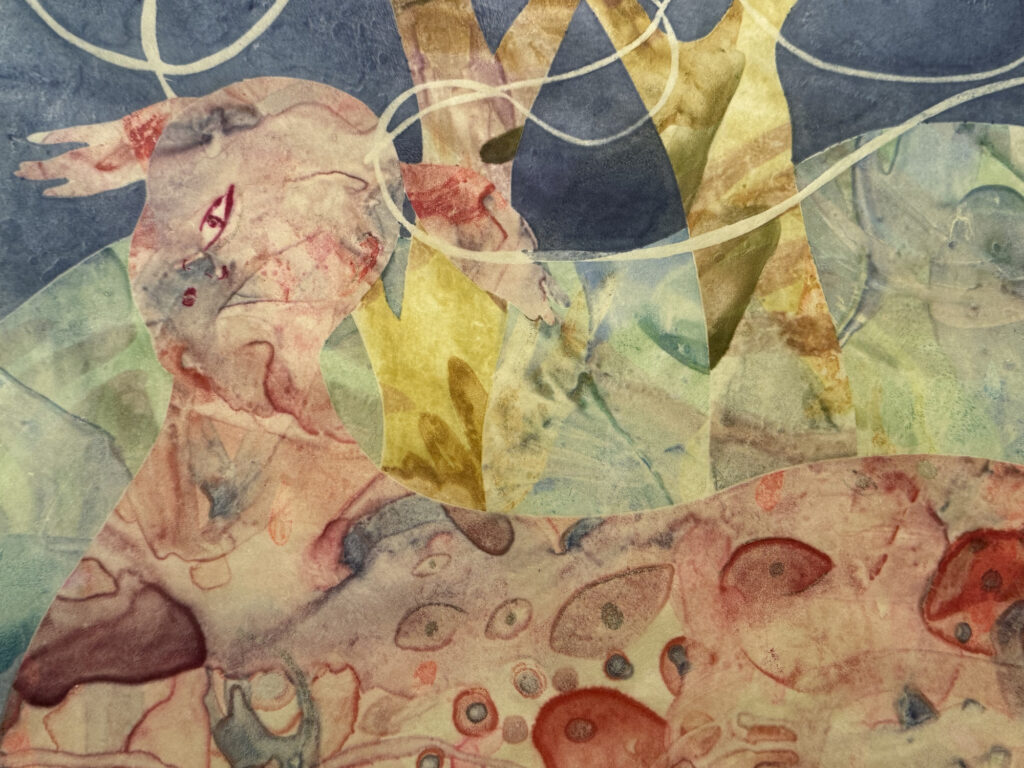
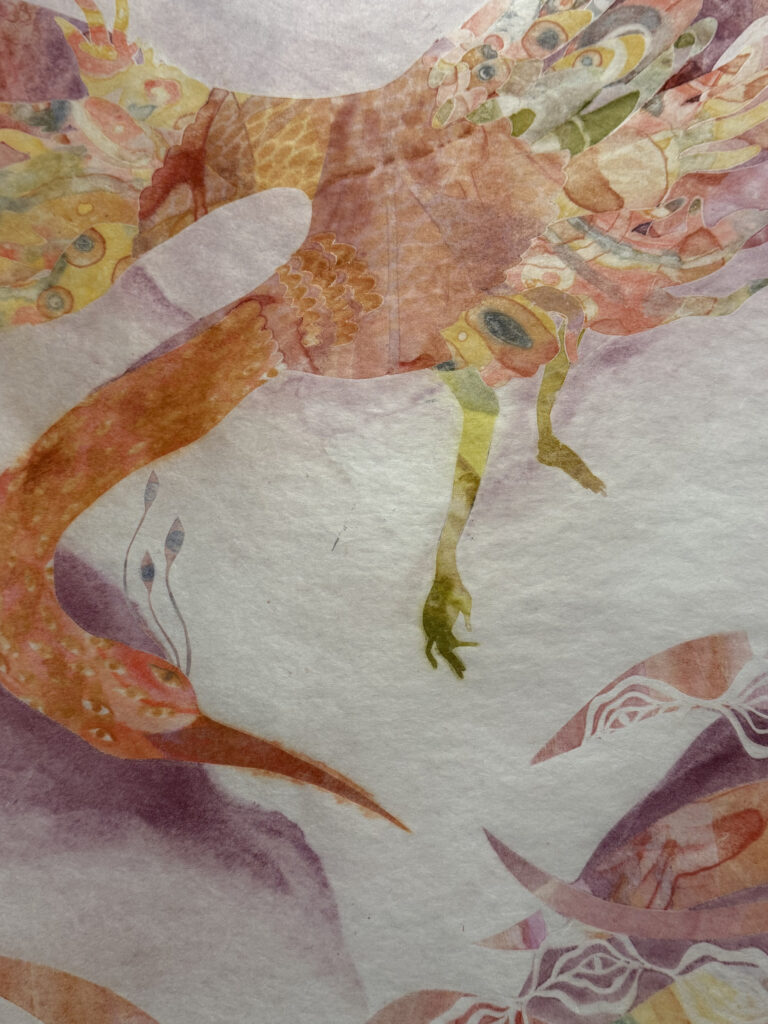
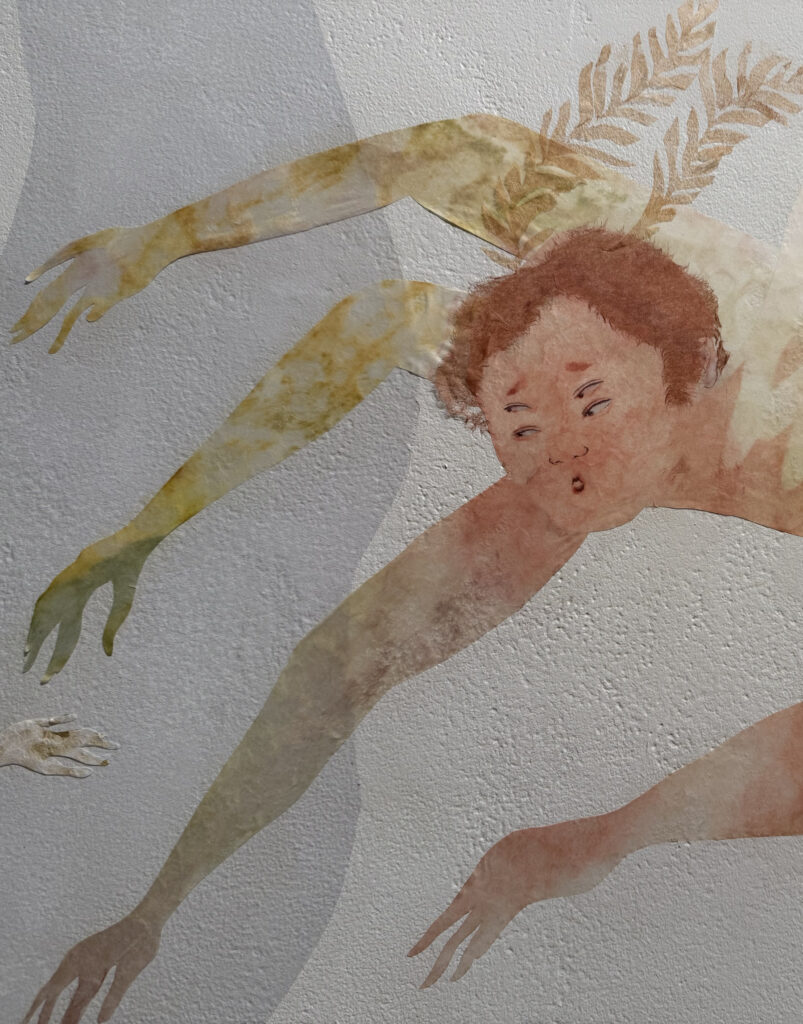
Flying figures are flexing their hands, feathers, wings in a shimmer of winter light. In Sanskrit, they are Apsaras. In Japanese paintings and stories they are called Tennin. Junli Song imagines them as sky beings, and as real to the touch as petals on the wind.
“They are often shown as beautiful women,” she said, “playing instruments and floating. In Japanese artwork and stories, the Tennin wear feathered garments called hagoromo that give them the ability to fly.”
They are crossing the mountains now in Garden of Memory, as artist Junli song opens her newest work at Massachusetts College of Liberal Arts Gallery 51 in downtown North Adams. Her show will run through March 6, with a performance that will bring this narrative to life.
A Garden of Memory
Multimedia artist Junli song opens her newest work at Massachusetts College of Liberal Arts’ Gallery 51 in North Adams — her show will run through March 6 and close with a performance to bring her narrative and imagined world to life. (This story also appears on btwberkshires.com
An artist and storyteller, in media, from printmaking and painting to sculpture and animation, Song explores imagined worlds and mythologies, and after a fellowship in printmaking at the University of Iowa, she is now the Gaius Charles Bolin fellow in the studio art department at Williams College.
She grew up in Chicago and has studied and traveled around the world, and here she is weaving Buddhist painting and sculpture and artforms from her family traditions.
She had a rare chance to come to China this past summer with her mother, she said, and she came to know her uncle’s work as a master lacquerware artist.

She also studied Chinese wood block printing in Chengdu, in Szechuan — a form she finds far deeper, wilder, more individual than the forms of Japanese printing more often known in the West. China is the forebear of the form, she said, and each print takes shape and life in the artist’s hands.
“I spent time with a printmaker,” she said, “a wonderful printmaker, and worked with her every day, and her sister, and they ended up becoming wonderful friends. … I wanted to learn about (the form) and balance the narrative, and bring some light to the birthplace of printmaking.”
‘I wanted to learn about the form and balance the narrative, and bring some light to the birthplace of printmaking.’
Well before this journey though, she has woven these forms and stories through her own work. In her installation in Iowa, she created an imaginary world that she called the Inbetween Cosmos, she said. And the world has grown organically.
Her work took root from a mythological figure, Xing Tian, in a Chinese text called the Shan Hai Jing — Shan means mountain and Hai means the ocean, so the English name is the Classic of the Mountains and the Seas.
“And I was so fascinated by this book,” Song said. “I had never seen it growing up. Even though every culture has a very rich world of mythologies, and I loved reading Greek and Roman myths, and I was fascinated by ancient Egypt and later by Assyria, for some reason I wasn’t really exposed to Chinese mythology.
“I stumbled across this book during my MFA and I really fell in love with it,” she said. “I guess it’s true for all mythology, that for the people of the time they were real. … They were part of the fabric of their lives. This ancient text was also a portrayal of how the ancient Chinese saw their actual world.”
The book was filled with geographies and plants, flora fauna, she said, and it also had segments of stories, fragments that stem from oral tradition, some binding into a coherent story.
Xing Tian was an assistant or warrior of the Flame Emperor, and when the Flame Emperor fought for power against the Supreme Being, Xing Tian lost his head, literally.
‘Souls would be planted, and they would then grow into flowers, and when the flowers bloom, the souls are ready to pass on to whatever comes after.’ — Junli Song
“And what I loved about his story was that he doesn’t die,” Sing said — “instead he metamorphoses. His nipples become eyes, and his navel becomes a mouth.
“I love this idea of a figure who ultimately cannot win but decides to keep fighting anyway and transforms in ways that are a bit strange and odd, but in a way in response to trauma, as a way to keep going, to keep resisting.”
She was also in a feminist class at the time, she said, and she loved this story as a symbol of resistance. So she made a female version of Xintian called Nu Xingtian, in sculpture and in clay — and imagined the world around her.
‘Souls would be planted, and they would then grow into flowers, and when the flowers bloom, the souls are ready to pass on to whatever comes after.’
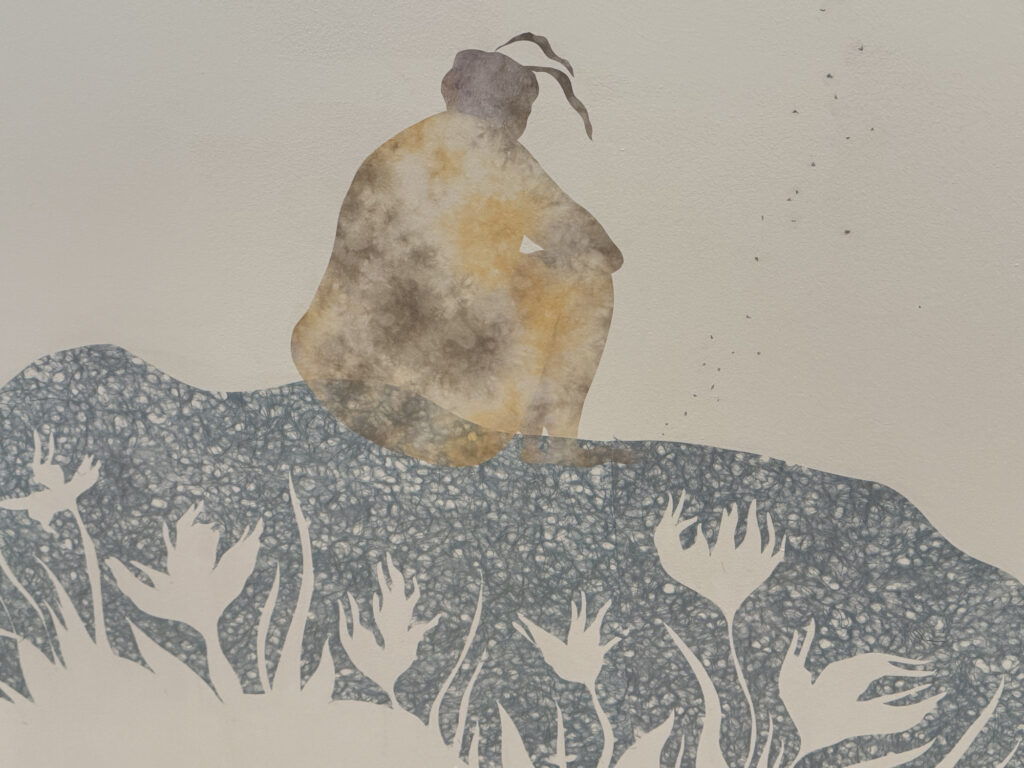
“One of the questions I have,” she said “… is the thought of what happens to souls when they die. I had the thought that they actually become seeds, and then they are planted within this garden. That’s where the idea of this garden of memory comes from.
“Souls would be planted, and they would then grow into flowers, and when the flowers bloom, the souls are ready to pass on to whatever comes after. This show is when I’m finally trying to bring the story to life. … And when the story unfolded, I found these deeply human aspects of them”
Who are the Tennin in her world, and their strengths and skills and shapes of mind?
She learned of them in Japan two years ago, on a trip to study and practice her art. She moved from city to city in a few months, she said. She remembers quiet moments and festivals, and a way of noticing time and detail.
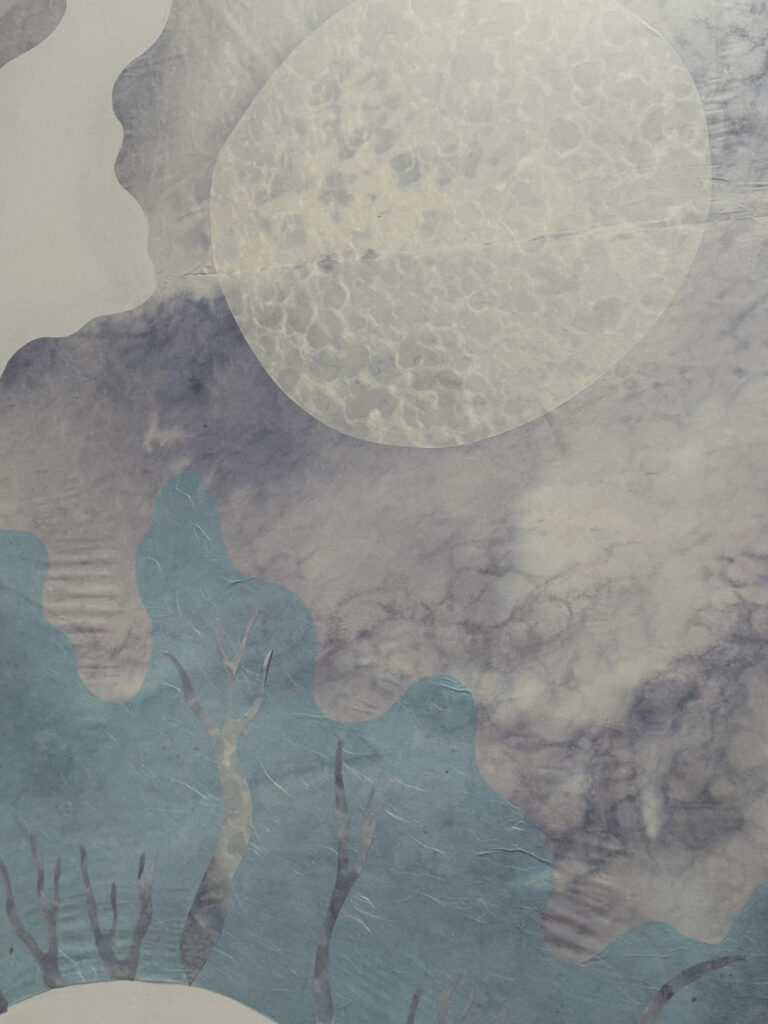
“The first month that I was there, I was living in a very old house, the former home of a Shinto priest. It was in Nara, which was one of the old capital cities, and it was a five-minute walk from their oldest Shinto temple. … feeling that history in your bones.”
The room where she had her studio had beautiful wooden beams, she said, and they had cutouts. At night she would see the light pass through the beams, and it would leave these beautiful shadows on the wall.
The idea of shadows began to infuse her artwork. She was reading “In Praise of Shadows,” a 1933 essay Jun’ichirō Tanazaki, and that work became an influence. In artwork too she kept noticing this a proponent of shadows, she said, and the way they would transform the space.
“Tanazaki describes Japan as having been a world of shadows,” she said, “before Western science came in and we got light bulbs — in flickering candlelight, shadows will move across the room. I found all that imagery incredibly inspiring for me, for me, and then of course being within spaces of temples where you have unique lighting as well. … that stayed with me.”
‘The room where she had her studio had beautiful wooden beams, and they had cutouts. At night she would see the light pass through the beams and leave beautiful shadows on the wall. ‘
In Buddhist sculpture one figure who influences her is the thousand-armed Kannon (Guanyin). She is a bodhisattva, and she opens her arms around her like wings.
Song’s Tennins began to fuel their own flight, beyond carrying and wearing hagoromo. And their hands hold more than air currents. In Buddhist imagery, she loved the mudras, hand gestures, she said.
The mudras can have many meanings. Buddhism moves across so many different cultures, , she said, and that translation manifests in the hands, where a movement can carry a new shade of meaning in Japanese, Tibetan, Indian or Chinese art or culture or language or faith.
“I’m drawn to these hands,” she said. “ … I love that they are a language. They’re a coded language, and so some people recognize them and some people don’t.
“… When I’m weaving them into the stories, I try to pick the gesture that I think is fitting …. For a more tender moment, a moment of offering, I would want to have the correct hand gesture, or for a moment of anger.”
‘I realized that the logic behind Chinese writing is exactly what I do within my art making. … Every character is unique, but elements reappear within this large body of characters.’
In earlier work, she has drawn on gestures from Peking opera. They have uses and meanings, she said, but some are more practical and less alive with feeling. A motion might mean holding a pen or carrying a tray or a fan. In her work, they became abstractions, and she gave them her own meanings in her world.
From Buddhism and Taoism, she learned an idea of impermanence that felt kin to her work, as she collages imagery on walls, drawing on elements of artwork from her earlier shows, moving and re-forming them into new relationships.
Here, in her residency at Williams College, she came to understand the way Chinese characters have formed over centuries.
“One of the highlights of my time there is that I started auditing Mandarin,” she said. “Before coming here, I did not know any Chinese writing. … And it has been such an eye-opening and somewhat overwhelming experience for me to start learning Chinese.”

She began learning because she wanted to travel in China and talk with family and friends and move more freely. And the more she learned, she said, the more the language related to her practice of collage and re-imagining.
“I realized that the logic behind Chinese writing is exactly what I do within my art making,” she said.”… Every character is unique, but elements reappear within this large body of characters.”
As she has dreamed her new Tennin, she started creating their figures based on Chinese writing. And then she began combining scripts to create new figures and new beings. And she found that transformation exciting.
“One of them I call Dangerous Hope,” she said. “She’s a three-headed creature with two arms and three legs and a tail … and I came up with this figure by combining characters. One means bright light, and one means knife, and so when I put them together I saw this three-headed being.”
Another one, a bird central to the story and her new art installation, has a body made of the forms for eternal and promise, she said. And so this bird offers hope to the wandering soul.
‘One of them I call Dangerous Hope … and I came up with this figure by combining characters. One means bright light, and one means knife, and so when I put them together I saw this three-headed being.’
“I would definitely say my time in China this summer was life-changing,” she said, “and also will be life-changing, I hope, because I’m planning to go back. I hope this summer, as soon as I can.
Her uncle wants her to come study with him, she said, and she hopes to make some of her new script beings with lacquerware. In the way he works, the lacquer covers bamboo, and bamboo is light and flexible as a medium for this translation, for strokes that can curve and be fluid and organic in space.
Having become an artist has brought her back in touch with her family and her heritage, she said:
“… I think a lot of people within diaspora experience this (experience) — you don’t have a lot of family that you know. Growing up it was just my parents and our closest family — I have an uncle and a cousin in Canada.
“A lot of my family members I’ve only met a couple of times in my life. And I had that sadness, that I couldn’t even speak to them when I saw them. And my Chinese still has a long way to go … but at least it’s starting to exist, and that felt wonderful.”